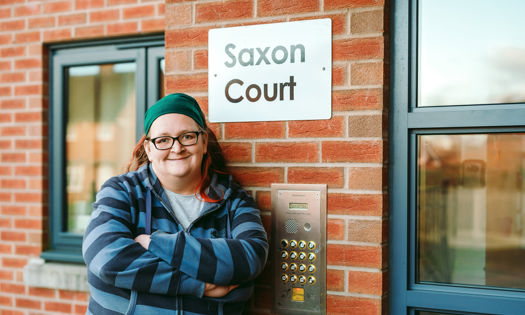
Having built a career in technology, Ian believed homelessness was something that happened to other people, not to someone like him. “I’m a professional person, ex‑military. I used to have an Audi in the driveway … and it goes in the blink of an eye”.
Having become homeless himself in 2022, Ian now reflects on how quickly stable lives can unravel and how easily individuals and families can find themselves without a home. Ian is 60 year old, ex‑armed forces, and now a Bromford customer.
After leaving the RAF in the 1980s, Ian spent most of his adult life working in technology, building a career he believed was secure. Ian most recently worked as a self employed technology instructor who went to different workplaces to teach people how to use IT systems. When Covid restrictions arrived in early 2020, that work stopped. Shortly afterwards, Ian suffered two strokes in rapid succession, one in December 2020 and another in January 2021.
Faced with the repercussions of his strokes, including memory problems, Ian was no longer able to return to teaching safely or reliably. Without income, savings began to run out and bills, including the rent, went unpaid. Social services became involved in attempts to reach an agreement with the family’s housing provider at the time, but Ian says those attempts were declined due to poor finances.
Ian, like thousands of other families, experienced how quickly homelessness can become a reality.
In September 2022, the family were evicted by their landlord at the time. After losing their home, Ian, his wife and their son initially stayed with friends before being placed in temporary, council‑owned accommodation. Ian describes this period as one of deep uncertainty, not knowing where they would be living from week to week.
What Ian and his family were experiencing was part of a much wider pattern. Families with children who lose their homes are often placed in temporary accommodation, sometimes for extended periods. Since Ian’s family became homeless, the number of children living in temporary accommodation has continued to rise. In 2025, government figures showed that 172,420 children in England were living in temporary accommodation, the highest number on record.
As weeks turned into months and housing applications were repeatedly declined because of the family’s financial position, Ian says their options began to run out. It was at this point, he explains, that they reached a moment of real desperation. As a former member of the armed forces, Ian contacted the Royal British Legion. He says the Legion “went to bat” for them, and that Bromford’s signing of the Armed Forces Covenant helped create a way forward.
Crucially, Ian says Bromford was the first organisation to visit and speak to them as a family, rather than planning based solely on paperwork.
He describes how a Bromford Neighbourhood Coach visited them in the flat they were living in at the time and took the time to sit with them, look them in the eye, and ask what had happened.
After months of being assessed only through forms and criteria, Ian says it was the first time he and his family felt treated as people rather than a case in a system.


More than a year on, Ian says “equilibrium has been restored”. For him, that doesn’t mean luxury or status, just security. He is now working to launch a charity to support ex‑service personnel with practical help in the event of homelessness.
Ian’s experience speaks to Bromford’s ambition, working as part of Bromford Flagship LiveWest to support communities where people can put down roots, recover from setbacks and plan for the future. As one of the UK’s largest providers of new affordable homes, delivering more than 3,000 each year and supporting over 300,000 customers, Bromford’s focus is not just on housing supply, but on long‑term stability.
For Ian, stability doesn’t mean status or material success. It means security, belonging and the chance to rebuild.